



Last Updated: 17 March 2026
Pair in Poker: Hand Rank & Best Strategy to Use
A pair in poker is a simple hand that appears frequently in games. This guide explains how a pair ranks, how you can get one, and what strategy works best.
GuidesWhat is a Pair in Poker?
A pair in poker consists of two cards of the same rank plus three unmatched cards. For example, 9♠ 9♦ A♣ 6♠ 2♥ is a pair of nines.
A pair is one of the most common hands in games like Texas Hold’em, formed from hole cards, the board, or both.
A pair ranks one above a high card (a single A, K, Q, or J) but below all other poker hands. Many players consider it a solid poker hand when it’s a top pair (face cards or 10s), but it is sometimes overvalued as well. Timing and position matter with a pair since even strong pairs will lose to better hands.
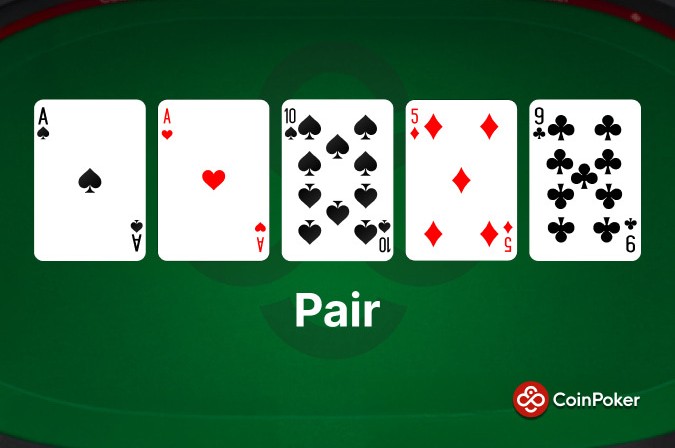
The best pair in poker is a pair of aces with the highest kickers: A♠ A♦ K♣ Q♠ J♠ is the strongest possible one-pair hand. It’s an attractive hand with five high-ranking cards, but it’s important to remember that it is still only one pair.
The Difference Between a Pair and a Pocket Pair
A pair and a pocket pair have the same rank, but are made in different ways:
A Pair
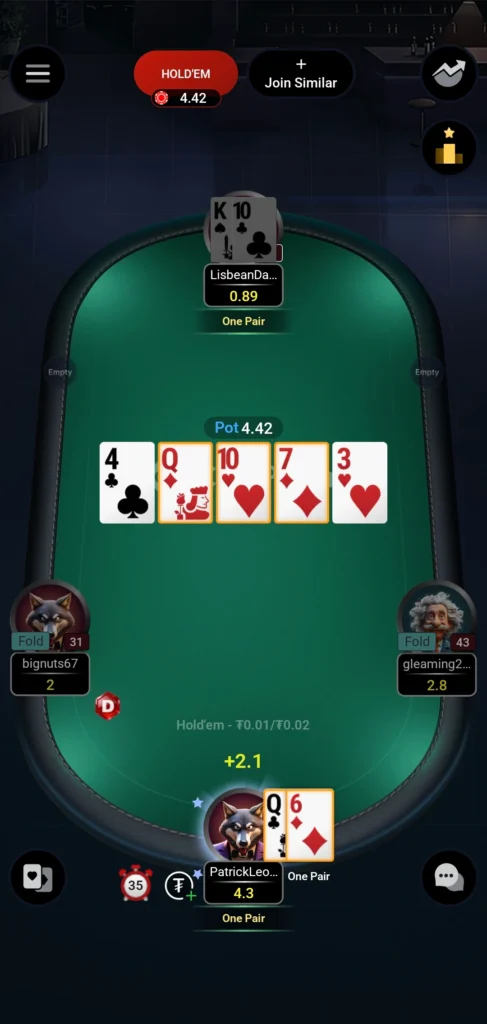
This means you have two cards of the same rank in your final hand, which can come from your hole cards or the community cards.
A Pocket Pair
This means that before the community cards, you start with two matching hole cards, such as 8♠ 8♦. While pocket pairs are seen as stronger preflops, pairs (using any community cards) and pocket pairs of the same rank hold equal strength at showdown.
How Does a Pair Rank in Poker?
A pair sits second-last in the poker hand rankings, above only a high card. It’s a hand you’ll see often during even a short poker session!
At the showdown, the rank of the pair determines the winner. For instance, a pair of kings beats a pair of eights. Kickers (the highest unmatched cards) decide the winner when two players have the same pair.
The best pair is aces (A♠ A♦), while the lowest pair is twos (2♠ 2♦). Pocket aces are a favorite in Hollywood poker movies; it’s good-looking and the strongest hand you can hold pre-flop. Twos, also called deuces, are the smallest pair and can be tricky to play.
What Beats a Pair in Poker?
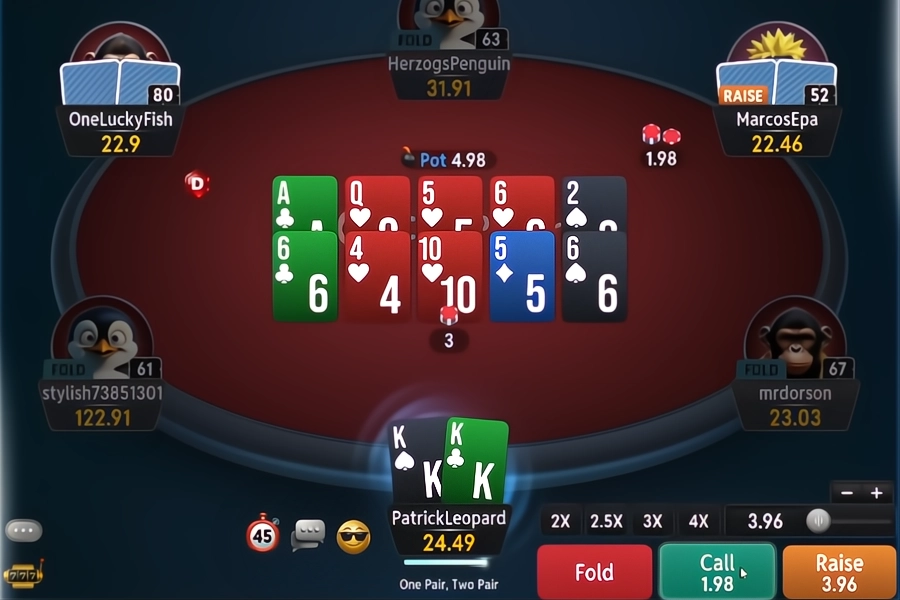
A better pair, two pairs, three of a kind, straights, flushes, full houses, four of a kind, straight flushes, and royal flushes all beat a pair.
Straight flush and royal flush aside, the hand is often beaten because these stronger holdings are relatively common. The chances of being outmatched in multiway pots increase, so consider the board and opponents before committing too heavily with just one pair.
What Does a Pair Beat in Poker?
A pair only beats a couple of different hands in poker.
It will always beat a high card hand. If your opponent fails to make at least a pair, your pair wins the pot at showdown.
A pair can also beat lower pairs. So, if you have a pair of Jacks and your opponent holds any pair with a lower value (such as a pair of Tens, Nines, etc), then you will win.
Pair vs Pair – Who Wins?
When two players have the same pair, the kickers decide the winner. Kickers are the highest unmatched cards in each hand, breaking ties between pairs.
For instance, Player A has A♠ K♣, and Player B has A♦ Q♠. The board shows A♥ J♣ 9♦ 3♠ 2♣. Both players have paired aces, and Player A wins due to his kicker of a K over the Q for Player B.
What is the Probability of Getting a Pair?
Knowing poker odds helps you evaluate the strength of your hand and plan your strategy. A pair in poker is one of the most common hands you’ll see, so let’s look at the odds of some pair situations:
| Situation | Your Hand | Board Stage | Community Cards | % Chance | Chance Odds |
|---|---|---|---|---|---|
| Flopping One Pair Exactly | A♠K♦ | Flop | A♣7♠2♦ | 26.94% | 1 in 3.71 |
| Making One Pair by the River (Unpaired Hand) | A♠K♦ | Flop to River | Q♣ 8♠ 2♥ → 6♣ → A♣ | 48.74% | 1 in 2.05 |
| Being Dealt a Pocket Pair | 8♣8♦ | Preflop | N/A | 5.88% | 1 in 17 |
The table shows that getting a pair is common in poker, especially by the river, whether from your hole or community cards. Being dealt a pocket pair is rare, but flopping a pair happens regularly.
What is the Probability of a Pair Improving?
A pair can improve to stronger hands like three of a kind, two pairs, or a full house – although this happens less frequently.
Let’s look at the odds of improving to trips with a pair:
| Situation | Your Hand | Board Stage | Community Cards | Odds | Chance % | Chance Odds |
|---|---|---|---|---|---|---|
| Flopped One Pair to Two Pair on the Turn | Q♠ 7♦ | Flop → Turn | Q♣ 8♠ 2♥ → 7♣ | 3 | 6.38% | 1 in 15.7 |
| Flopped One Pair to Two Pair by the River | Q♠ 7♦ | Flop → River | Q♣ 8♠ 2♥ → 6♣ → 7♣ | 3 | 12.49% | 1 in 8.01 |
| Flopped One Pair to Improve to Trips by River | 9♠ 4♣ | Flop → River | 9♦ 7♥ 2♠ → 8♠ → 9♥ | 2 | 8.42% | 1 in 11.8 |
| Flopped Set to Full House by the River | 8♣ 8♦ | Flop → River | 8♥ 6♠ 3♦ → 2♣ → 3♣ | — | 29.42% | 1 in 3.40 |
| Flopped Set to Quads by the River | 8♣ 8♦ | Flop → River | 8♥ 3♠ 2♦ → 6♠ → 8♥ | 1 | 4.26% | 1 in 23.50 |
One Pair Strategy: 3 Effective Tips for Playing a Pair
Playing one pair well demands a solid strategy to maximize value and avoid costly mistakes. Below are three essential tips to improve your pair play.
The more opponents you face, the weaker your pair becomes. Understanding the limitations of a pair, especially in multiway pots, is a strong basic poker strategy. As the number of opponents increases, so does the likelihood that someone holds a stronger hand, like two pairs or trips.
This is a fundamental strategy for beginners to avoid overcommitting chips with just a single pair. Avoid building large pots without strong kickers or reliable reads on your opponents.
Many players fall into predictable patterns when playing poker, especially when holding one pair. Patterns include calling or checking pre-flop with a weak pocket pair, or betting aggressively with a strong pocket pair, then checking passively later on.
These habitual actions and reactions make you easy to read and exploit with hands like a pair. Habits are easily formed and play a role in the psychology of poker, so try to adjust your strategy based on table dynamics and opponents rather than relying on comfortable patterns.
Aggression in poker is a powerful tool for shaping your table image when playing a pair. Betting and raising with your pairs projects confidence and strength, making opponents more likely to fold marginal hands. This works well if you’ve built a chip lead or opponents have previously seen your strong winners at showdown.
Avoid unnecessary aggression with a pair if you’re low on chips or your table image is loose, as you’re more likely to face a call from average hands. Use aggression thoughtfully with pairs, and always consider your recent history at the table.
Win With Pairs at CoinPoker & Grab a $2,000 Bonus
It’s time to put your newly found pairs knowledge to the test. Now that you know how and when to play a pair, CoinPoker has a seat in hundreds of cash games and tournaments waiting for you. Start small with low-stakes games and hop into higher-stakes games as you improve your skills.
We have a juicy 150% deposit bonus up to $2,000, available when you register at CoinPoker with just your email address!
Frequently Asked Pair Questions
Yes, but the chances decrease as more players remain in the hand.
Trips include a pair plus one on the board; a set is a pocket pair plus one matching card on the board.
Higher kickers improve your chance of winning when pairs tie.
Yes, they often lead to strong hands like sets after the flop.
About 12% of the time, or roughly one in eight flops.

Explore More


Guides
The go-to resource for mastering poker with expert tips and strategies. Our guides will elevate your poker skill level.
66 Posts
News
Find the latest poker news and latest CoinPoker Newsletters. Get updates about games, promotions, and crypto news.
90 Posts